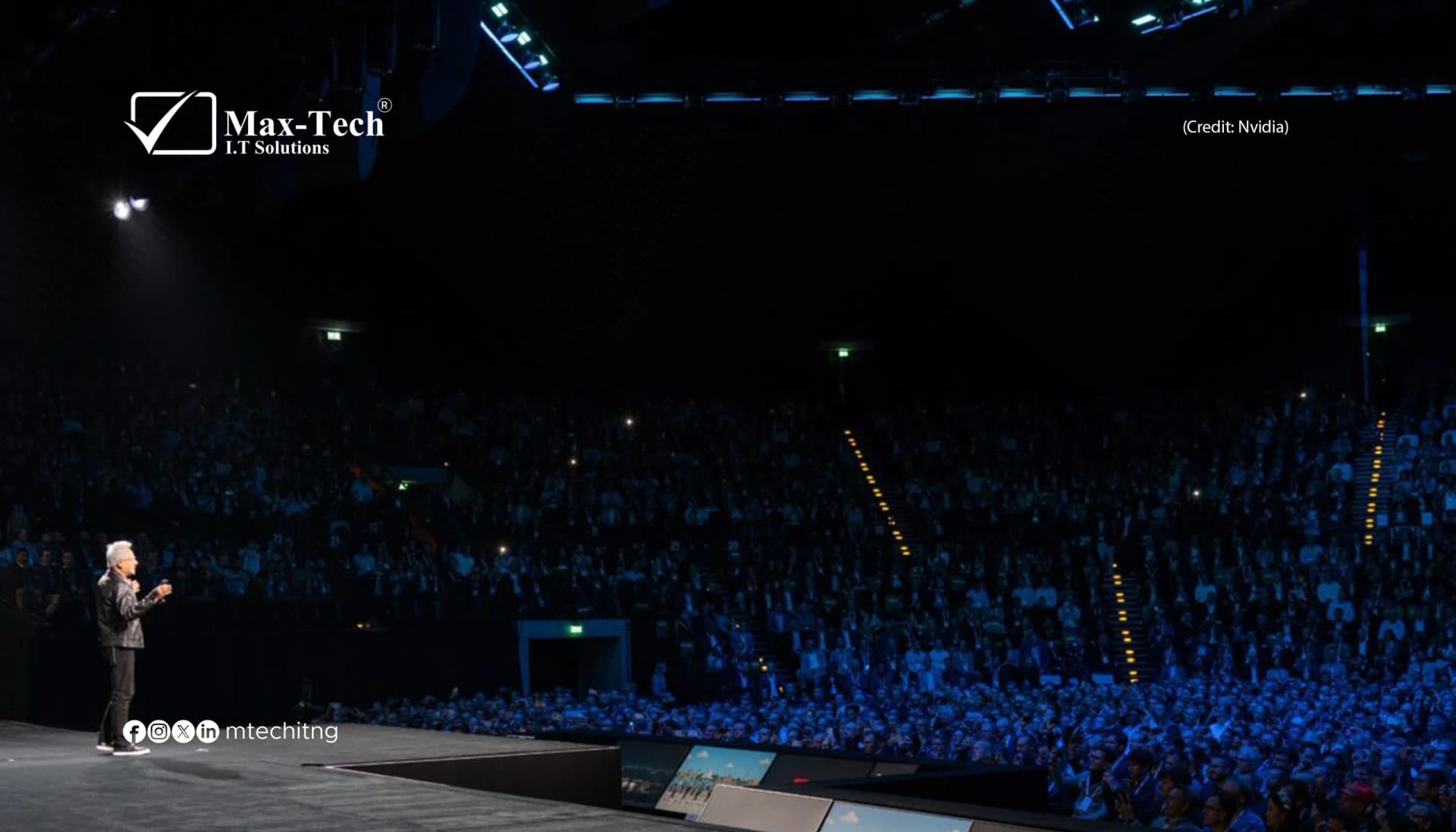

NVIDIA GTC Berlin 2026 brought together developers, researchers, technology companies, and industry leaders to explore the next generation of artificial intelligence, robotics, and accelerated computing. Held from October 20 to 22 in Berlin, Germany, the event featured more than 100 sessions, hands-on workshops, technology demonstrations, and announcements focused on how AI is moving beyond chatbots into business operations, scientific research, manufacturing, and autonomous systems.
1. AI Agents Take Center Stage
One of the major themes at GTC Berlin was agentic AI. Unlike traditional AI assistants that primarily respond to prompts, AI agents can work through multiple steps, use software tools, retrieve information, and carry out tasks with varying levels of autonomy.
NVIDIA highlighted technologies designed to help developers build and deploy these agents more effectively, including tools for managing agent execution, securing access to resources, and scaling AI workloads. For businesses, this could mean more automated workflows, improved customer support, faster information processing, and new ways to manage repetitive tasks.
2. New Tools for Robotics and Physical AI
NVIDIA also expanded its Cosmos platform, which provides models, datasets, and tools for developing physical AI systems. These technologies help developers train and evaluate systems that need to understand and interact with the physical world, including robots and autonomous machines. The company introduced additional training tools, simulation checkpoints, and data-generation resources designed to support the development of these systems. Physical AI has potential applications in manufacturing, logistics, industrial automation, and autonomous vehicles, where systems must interpret their surroundings and respond to changing conditions.
3. New AI Infrastructure for Enterprises
As AI workloads grow, companies need computing infrastructure capable of supporting increasingly demanding applications. At GTC Berlin, NVIDIA highlighted advances in AI infrastructure, including its Vera Rubin computing platform and expanded ecosystem of European cloud partners.
These developments focus on providing the processing power, networking, and deployment capabilities needed to train and run AI models at scale. NVIDIA also discussed sovereign AI infrastructure, which enables organizations to develop and operate AI systems while maintaining greater control over their data, computing environments, and regulatory requirements.
For European businesses and research institutions, local AI infrastructure can be particularly important when handling sensitive information.
4. NVIDIA Minerva Targets AI Infrastructure Monitoring
One of the announcements on October 22 was NVIDIA Minerva, an AIOps platform designed to improve observability across AI infrastructure.
The platform brings together telemetry from infrastructure and AI workloads, then uses specialized AI models to help identify problems earlier and provide actionable insights. As organizations deploy larger AI systems, monitoring performance, identifying failures, and maintaining reliable operations become increasingly important. Tools such as Minerva aim to help infrastructure teams understand what is happening across complex AI environments and respond to issues more efficiently.
5. Faster Scientific and Engineering Simulations
NVIDIA also announced the general availability of cuDSS, a CUDA-X library designed to accelerate the solution of large sparse systems of equations.
These calculations are important in scientific computing, engineering simulations, and other workloads where complex mathematical problems can limit performance. By using GPUs to accelerate these computations, cuDSS can help researchers and engineers explore more designs and run certain simulations more efficiently. Potential applications include materials research, industrial design, and scientific modeling.
6. Open Models and AI Development Tools
Open models were another important part of the event.
NVIDIA highlighted expanded model offerings and development tools covering business data, retrieval, document processing, physical AI, healthcare research, and other specialized applications. These resources give developers and organizations more options for adapting AI models to their own requirements and deploying them on infrastructure they control.
For startups and technology teams, open models can offer greater flexibility when building specialized AI products, although licensing terms, hardware requirements, and operational costs still need to be considered.
7. What GTC Berlin Means for Businesses
The announcements at GTC Berlin reflect a broader shift in the technology industry. AI is increasingly being developed as a complete system involving models, software tools, computing infrastructure, networking, and security.
Businesses exploring AI should consider several practical priorities:
- Automation: Identify workflows where AI agents could reduce repetitive work.
- Infrastructure: Evaluate the computing resources required to run AI applications reliably.
- Security: Establish clear controls over what AI agents can access and do.
- Data governance: Determine how sensitive business information will be stored and processed.
- Skills development: Train employees and technical teams to implement and manage AI systems effectively.
The most valuable AI investment will depend on a company's goals, available resources, and ability to integrate new technology into existing operations.
Final Thoughts
GTC Berlin 2026 highlighted how artificial intelligence is expanding into business automation, robotics, scientific research, and large-scale computing infrastructure. From NVIDIA's Minerva platform and Cosmos tools to advances in accelerated computing and open models, the announcements point toward an industry increasingly focused on deploying AI in practical, real-world environments.
For developers, businesses, and IT professionals, the challenge is no longer simply understanding what AI can do. It is determining how to deploy it securely, efficiently, and responsibly.
At Max-Tech I.T. Solutions, we follow developments like these to help businesses stay informed about emerging technology and digital innovation.