
Apple is expanding its Health app experience with new AI-powered insights, personalised recommendations and broader language support, making it easier for users to understand their health and wellbeing.
Announced on 3 November 2026, the redesigned experience introduces 11 language options alongside new tools for tracking long-term health trends, monitoring fitness and assessing physical performance.
Health Insights in 11 Languages
The redesigned Health app supports 11 language options:
- English (Global)
- Chinese (Simplified)
- Chinese (Traditional)
- French
- Japanese
- Korean
- Norwegian
- Portuguese
- Spanish
- Turkish
- Vietnamese
The expanded language availability is intended to make Apple's health features accessible to more people around the world.
A More Personalised Health Experience
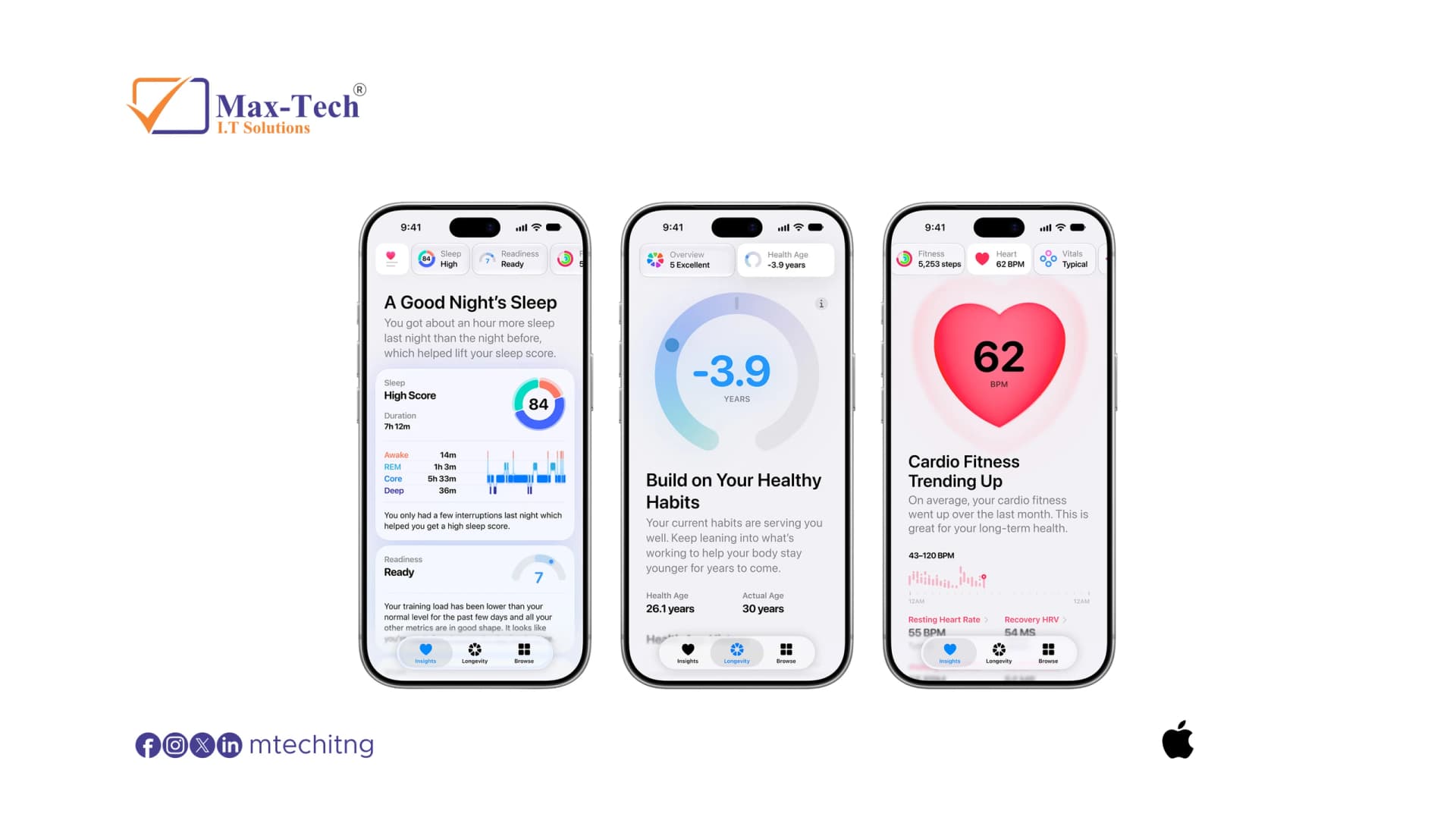
Apple is introducing a new Insights tab that brings together information from different health categories, including heart health, sleep, fitness, readiness, vital signs and cycle tracking.
The feature provides summaries throughout the day, helping users identify changes in their health metrics and understand patterns over time.
The new For You section also delivers personalised recommendations based on individual health information and daily habits.
For example, users experiencing interrupted sleep over several nights may receive suggestions for improving their bedtime routines.
Apple is also incorporating educational videos and articles featuring health experts to help users better understand their health information.
Health Age and Long-Term Wellbeing
Another major addition is the Longevity tab, which focuses on long-term health trends.
It covers several areas, including:
- Heart health
- Sleep
- Mental wellbeing
- Movement
- Metabolic health
- Hearing
- Nutrition
The feature also introduces Health Age, which uses selected health measurements to help users understand how their body is tracking relative to their chronological age.
It draws on Apple Watch measurements such as VO₂ max, resting heart rate, sleep and heart rate variability.
Users can also incorporate clinical laboratory results, including A1c and LDL cholesterol, to provide additional context.
Health Age is intended as an informational tool, not a medical diagnosis.
At-Home Fitness and Movement Assessments
Apple is also introducing at-home movement assessments that allow compatible users to evaluate their physical performance without specialised equipment.
Using an iPhone camera and Apple Watch, users can assess:
- Flexibility
- Strength
- Balance
- Movement mechanics
- VO₂ max
The assessments provide real-time audio and visual feedback.
Apple says the feature uses on-device vision-based AI models developed with clinical experts. Video is not recorded, stored or shared during the assessment.
Privacy and Device Compatibility
Apple says the redesigned Health experience is designed to protect personal health information.
The new features require compatible Apple hardware and supported software. Some capabilities are available only on iPhone, while Health Age requires an Apple Watch.
VO₂ max assessments can use an Apple Watch, AirPods Pro 3 or a compatible third-party heart-rate sensing device.
Availability may also depend on region, language and age requirements.
When Can Users Get the New Features?
The redesigned Health experience is currently available through the iOS 27.3 developer beta.
Apple plans to distribute it as a free software update later in 2026. Users should check Apple's official announcements for general availability and device compatibility information.
Final Thoughts
Apple's latest Health app improvements reflect the growing role of artificial intelligence in personal health technology.
With personalised recommendations, Health Age, at-home movement assessments and expanded language support, Apple is giving users more ways to understand their health information and monitor long-term wellbeing.
The redesigned experience also highlights the importance of combining useful AI capabilities with privacy-focused processing and accessible