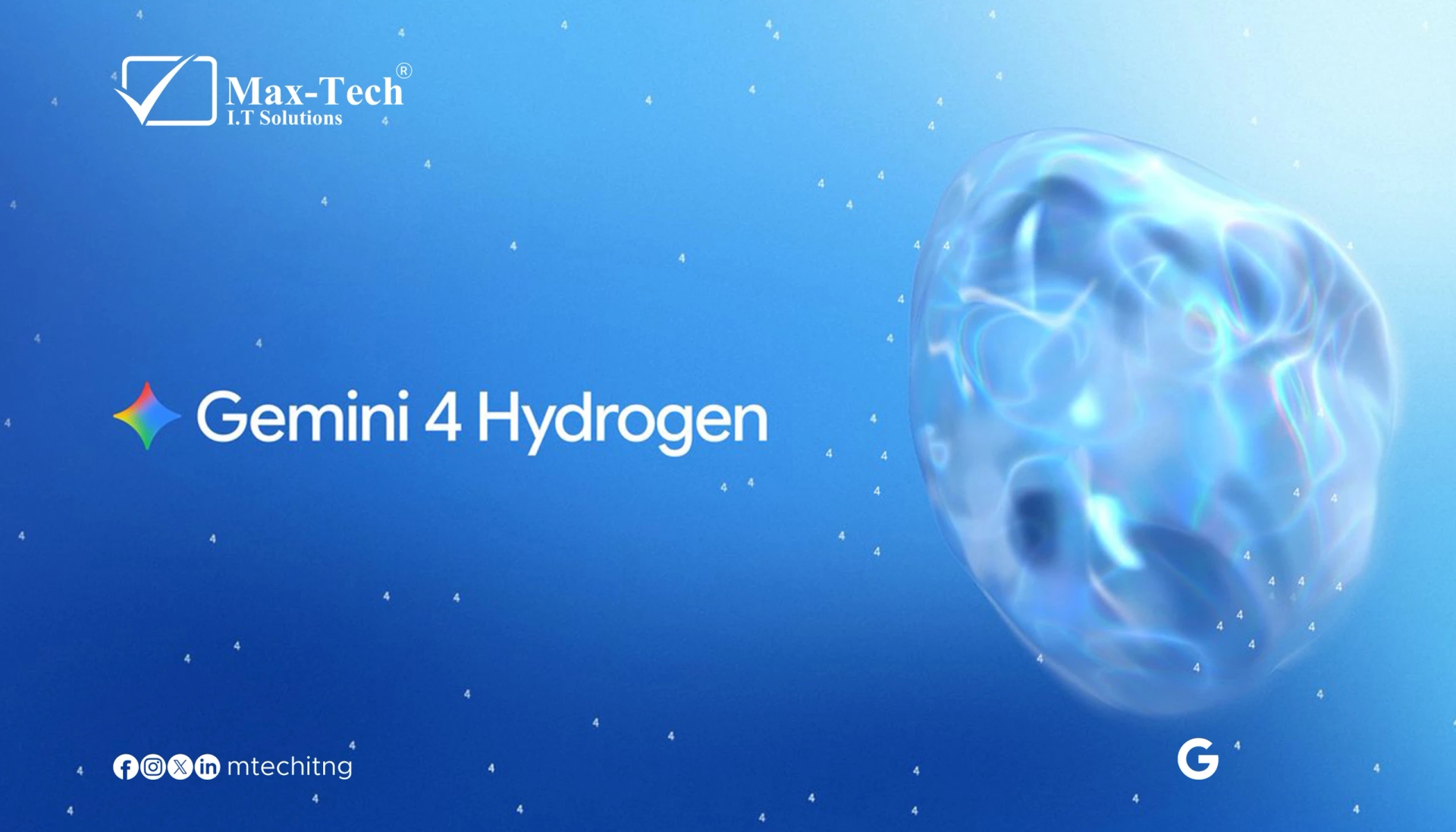

Google has introduced Gemini 4 Hydrogen, a new artificial intelligence model designed to make advanced AI assistance faster, more accessible and efficient for everyday tasks.
Announced on November 12, 2026, the model is rolling out across Google's AI ecosystem, including the Gemini app, Google Search, Google AI Studio, the Gemini API and business services.
The announcement is particularly significant for free Gemini users, who can now access the new model through automatic model selection when it is appropriate for their prompts.
What Is Gemini 4 Hydrogen?
Gemini 4 Hydrogen is Google's latest model for everyday AI assistance, coding and agentic workflows.
Unlike Google's more advanced Gemini 4 Carbon and Gemini 4 Argon models, which are designed for deeper and more complex reasoning tasks, Hydrogen focuses on speed, efficiency and handling practical tasks.
Google says the model is designed to help users complete everyday work with fewer prompts and less back-and-forth.
Its capabilities include:
- Writing and editing documents.
- Researching and summarising information.
- Understanding uploaded files.
- Coding and software development.
- Handling multi-step instructions.
- Working with connected applications.
- Building interactive prototypes.
The model also supports a context window of up to one million tokens, allowing it to process large amounts of information in supported environments.
Free Users Can Access Gemini 4 Hydrogen
One of the biggest announcements is the expansion of Gemini 4 Hydrogen to free users.
Google is making the model available through automatic model selection in the Gemini app.
This means free users do not necessarily need to subscribe to a paid Google AI plan to benefit from Hydrogen.
However, there is an important distinction: free users do not have unrestricted manual access to select Hydrogen whenever they want. Google automatically uses it when the prompt requires its capabilities.
Gemini 4 Hydrogen is also available through Google Search, bringing its improved reasoning and response capabilities to a wider audience.
Improved Reasoning and Everyday Productivity
Google says Hydrogen has been designed to follow instructions more accurately and handle complex requests more efficiently.
For example, users can provide multiple requirements in one prompt and receive responses that address different parts of the task.
The model can also help users:
Write and research: Produce emails, reports, study materials and structured documents while following requested formats and instructions.
Analyse information: Compare products, summarise lengthy documents and organise information into tables and visual breakdowns.
Work with connected services: Access relevant context from uploaded files and supported connected applications such as Gmail and Google Drive, subject to permissions.
Build prototypes: Turn ideas into working layouts and interactive projects with fewer prompts.
These improvements are intended to make AI assistance more useful for everyday professional and personal activities.
A New Upgrade for Google Search
Google is also bringing Gemini 4 Hydrogen to Search globally.
The update improves how Google understands complicated and multi-part questions.
Instead of treating every question as a simple keyword search, the upgraded experience can break complex requests into related topics and conduct multiple searches to identify useful information.
Google says users can expect:
- Better understanding of detailed questions.
- Improved handling of spelling mistakes and unclear instructions.
- More relevant website links.
- Richer visual answers.
- Structured information, including tables and images.
- More useful responses across supported languages.
This represents another step in Google's transition towards more AI-assisted search experiences.
Four Thinking Levels for Different Tasks
Gemini 4 Hydrogen introduces four thinking levels:
- Low: For simpler tasks where speed is important.
- Medium: For tasks requiring a balance of speed and reasoning.
- High: The default setting for more detailed responses.
- Xhigh: For tasks requiring additional reasoning depth.
These options allow supported users and developer environments to balance response quality, speed and resource consumption.
Google also reports that Hydrogen scored 51 on the Artificial Analysis Intelligence Index at its default high thinking level, compared with 50 for Gemini 4 Argon at its high setting.
These are benchmark results rather than guarantees of better performance on every task.
What This Means for Developers
Gemini 4 Hydrogen is not limited to the consumer Gemini app.
Developers can access it through Google AI Studio and the Gemini API, while eligible business customers can use it through supported Google business services.
Google is also introducing Orchestrator in Google Antigravity.
This feature can dynamically switch between models such as Gemini 4 Carbon and Hydrogen during a development session.
The idea is to use a more advanced model for complex planning and another model for faster execution, testing and verification.
Google reports that this approach achieved near-Carbon task success rates on Terminal-Bench 4.0 while using 24% less quota and completing tasks 19% faster on average.
Where Can You Access Gemini 4 Hydrogen?
The model is rolling out across Google's platforms:
- Gemini app: Free users can access Hydrogen through automatic model selection.
- Google Search: Available globally as part of Google's upgraded AI-powered search experience.
- Google AI Studio: Available for developers.
- Gemini API: Available for developers building AI-powered applications.
- Gemini for business: Available through supported business offerings.
- Google Antigravity: Available to eligible Google AI Pro and Ultra subscribers.
Availability and usage limits vary by platform and subscription.
AI Is Becoming More Accessible
Google's Gemini 4 Hydrogen announcement highlights the growing competition to make advanced artificial intelligence available to more people.
By bringing its latest everyday model to free users through automatic selection, Google is lowering the barrier to accessing more capable AI assistance.
For students, developers, business owners and professionals, this creates additional opportunities to use AI for research, productivity, software development and everyday problem-solving.
At Max-Tech I.T Solutions, we believe that understanding and adopting useful technology can help individuals and businesses work more efficiently.
The next phase of AI is not just about building more powerful models. It is about making those capabilities useful and accessible to more people.
Source: Google DeepMind and Google Blog, November 12, 2026.