
If you're not deep into tech specs, the headlines can sound like noise. So here's what actually changed, why it matters, and who each machine is really built for.
The New Mac mini: Small Box, Bigger Brain
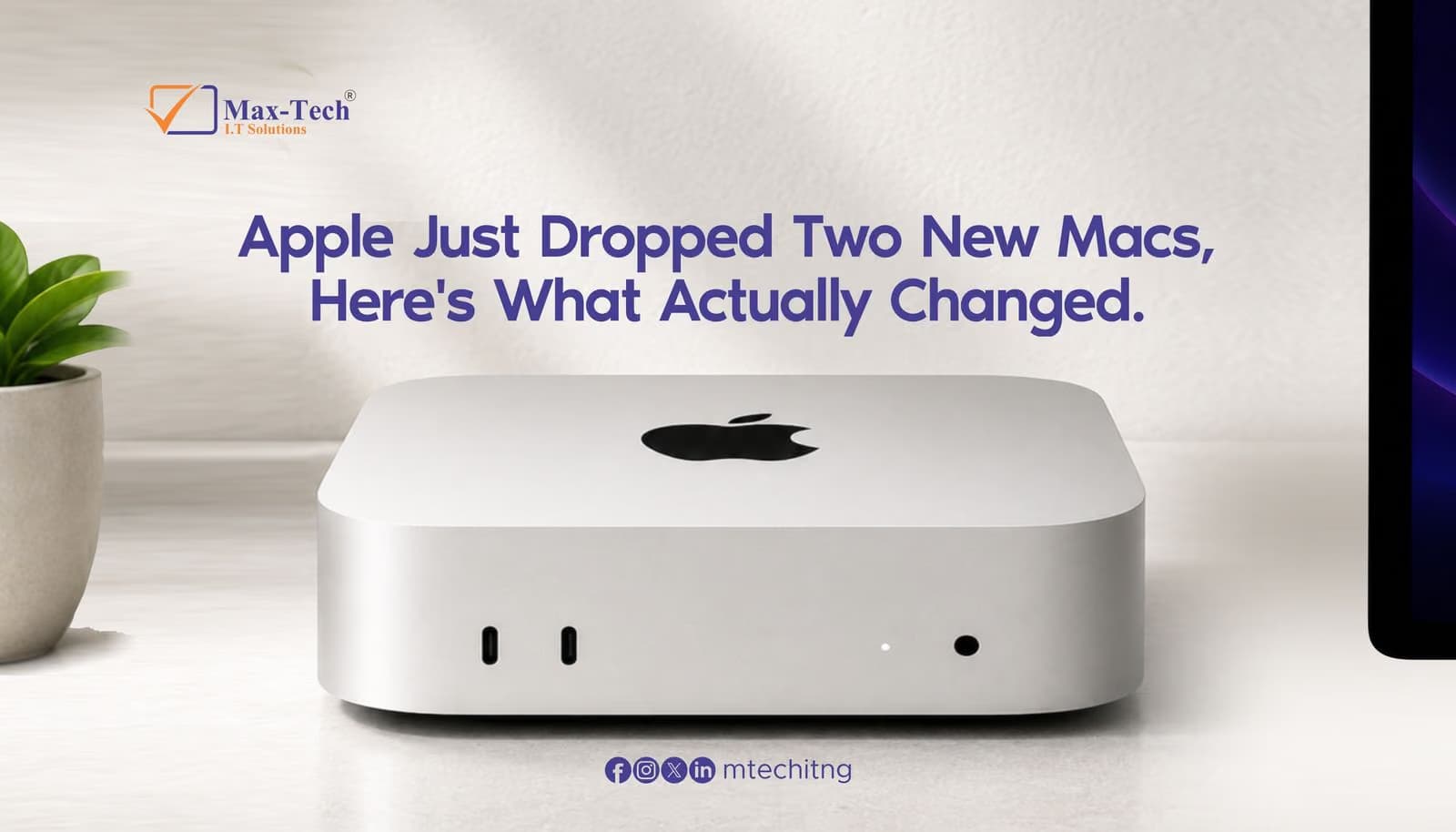
The Mac mini keeps its famously compact design, but what's inside it has taken a real leap forward.
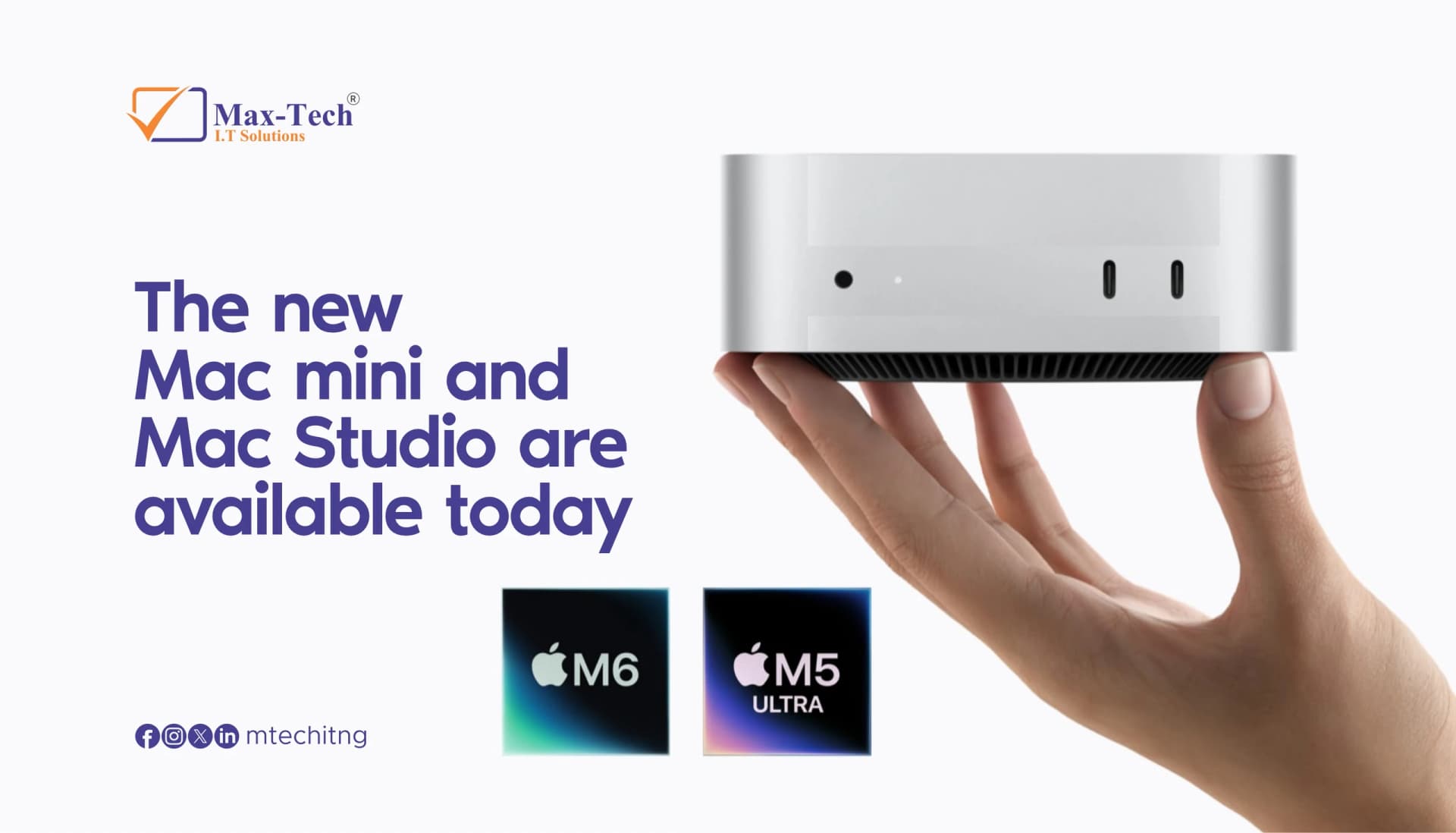
For the first time, Apple is offering the Mac mini with its new M6 chip the company's first chip built on a 2‑nanometer manufacturing process. In plain terms: a smaller manufacturing process generally means more computing power packed into the same space, using less energy. It's one of the more significant under-the-hood shifts Apple has made to its chip lineup in a while.
The M6 chip brings:
- A 12‑core CPU and 12‑core GPU.
- Apple's first-ever dual Neural Engine two separate 16‑core engines dedicated to AI processing.
- Up to 4x faster AI performance, 2x faster graphics and storage, and 40% faster overall CPU performance compared to the previous M4-powered model.
If you want even more power, there's also an M5 Pro configuration, the same chip that debuted in this year's MacBook Pro available with up to an 18‑core CPU and 20‑core GPU.
Connectivity got an upgrade too: Wi‑Fi 7 and Bluetooth 6, replacing the previous Wi‑Fi 6E and Bluetooth 5.3.
- Pricing: The M6 model starts at $899, and the M5 Pro model starts at $1,699 both $100 more than the outgoing generation.
- Who it's for: Everyday productivity users who want a fast, compact desktop, and increasingly, anyone who wants a machine that can comfortably handle AI-assisted tasks running directly on the device rather than in the cloud.
The New Mac Studio: Apple's Most Powerful Mac Yet
If the Mac mini is Apple's "does it all, small footprint" machine, the Mac Studio is built for people who need serious, sustained processing power video editors, 3D artists, developers, and increasingly, people building and running AI models locally.
The new Mac Studio comes in two chip tiers, and for the first time, both are from the same chip generation:
- M5 Max: 18‑core CPU, up to a 40‑core GPU, up to 128GB of unified memory, and third-generation hardware-accelerated ray tracing.
- M5 Ultra: Apple's most powerful chip yet up to a 36‑core CPU and an 80‑core GPU (the most powerful GPU Apple has ever built), with Neural Accelerators on an Ultra-tier chip for the first time. Apple says this brings up to 4.3x faster AI performance compared to the previous M3 Ultra.
Perhaps the most notable number: the Mac Studio can now be configured with up to 512GB of unified memory (this top configuration ships in late October, slightly after the rest of the lineup). For context, that's the kind of memory ceiling that lets people run large AI models directly on their own machine no cloud servers required.
Other upgrades include support for up to 8 external displays, Thunderbolt 5 "clustering" for distributed AI workloads across multiple machines, and faster PCIe Gen 6 storage.
Pricing: The M5 Max model starts at $2,499, and the M5 Ultra model starts at $5,499.
What's the Bigger Story Here?
Strip away the individual spec numbers, and a clear pattern emerges: Apple is building its desktop lineup around on-device AI. Faster Neural Engines, more Neural Accelerators, and dramatically higher memory ceilings all point in one direction machines capable of running AI workloads locally, rather than depending entirely on the cloud.
For everyday users, that might mean smoother, faster AI-assisted features baked into daily tasks. For businesses and IT decision-makers, it's a signal worth paying attention to: on-device AI capability is quickly becoming a standard expectation for new hardware, not a premium add-on.
The Practical Details
- Both the Mac mini and Mac Studio are available for pre-order now.
- Standard configurations begin shipping September 22, 2026.
- The top-tier 512GB Mac Studio configuration ships in late October.
Apple also quietly refreshed its Magic Keyboards and introduced a lower-priced Polishing Cloth on the same day minor updates, but part of the same announcement.